SF Chronicle – As Waymo incidents pile up, here’s what the company should do to earn trust
Editors note: If Waymos are so safe then why does Waymo do everything possible to keep the public and the government from getting all the details???
See original opinion piece by Bryant Walker Smith in the SF Chronicle
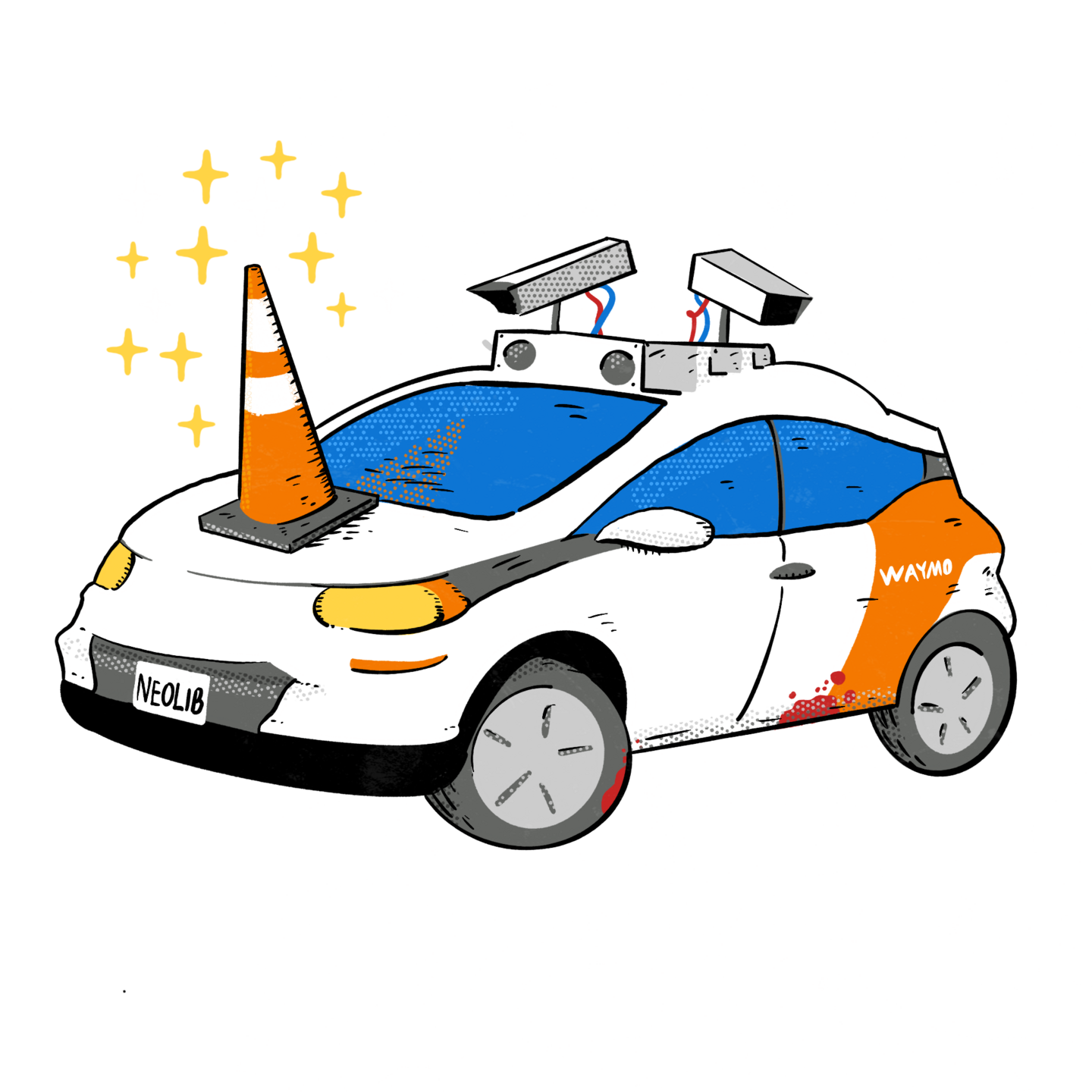
On Nov. 5, three Waymo vehicles drove into a construction zone on U.S. 101 near Burlingame, leading the California Department of Motor Vehicles to ban the company’s driverless taxis from the state’s freeways. (I am a DMV adviser but was not involved in this decision.)
Waymo’s statement that its recent “encounters on U.S. 101 … did not involve any injuries or collisions” encapsulates the debate over the use of autonomous vehicles. While you might have read about Waymo’s recent injury-free incidents, you probably didn’t hear about the three construction workers killed on I-10 near Blythe (Riverside County) when a human driver in a big rig struck a series of construction vehicles.
Are you concerned about autonomous driving? Good. As long as you’re also terrified about human driving.
At the same time, “no harm, no foul” is a dangerous rule for our roads. Luck can be the difference between a near miss and a fatal crash, and enough bad luck could turn an automated vehicle incident into a disaster. The San Francisco Municipal Transportation Agency reported that a disabled Waymo delayed an ambulance’s arrival by 40 minutes during a December blackout. Dozens of Waymo robotaxis got stuck after the city’s July Fourth fireworks show. In a future earthquake, thousands of autonomous vehicles rendered immobile could compound the catastrophe.
Special sensitivity to what automated driving companies are doing on our roads is therefore understandable. Looking at Waymo, there is a lot to like. The company shares its statistical methodologies for assessing safety and its results. On the surface streets covered by its published comparisons, Waymo credibly reports substantially fewer crashes involving serious injury or death per mile than its human-driving benchmarks.
There are also points of concern. A video showed a beloved San Francisco cat under a stopped Waymo robotaxi, near its right front tire, for about 25 seconds before the vehicle pulled away and killed it. When the company has identified a problem — from construction zones or school buses — the solution can be elusive. As part of its earlier flooding recall, Waymo tightened weather restrictions and changed its maps. Yet this week two Waymo robotaxis were awkwardly blocking traffic at flooded San Francisco intersections. As these vehicles — or their remote human agents — pause to decide what to do, they can make life more difficult for other road users.
Do human drivers cause similar problems? Absolutely. But a driver who repeatedly makes the same mistake invites scrutiny. Every Waymo vehicle has the same driver, and that driver is Waymo itself.
So how can this special driver do better?
First, Waymo should publicly share its safety story across time. Each of its safety-relevant performance issues should have a webpage explaining, with regular updates, what the company knows, what it doesn’t, what it’s doing to address the issue, how it’s managing risk in the interim and what has changed since the last update.
Second, Waymo should explain how it makes safety decisions generally and how it has made each safety decision specifically. The company’s internal safety board consists of three members of its C-suite. On the day California ordered Waymo’s robotaxis off its freeways, the company paused commercial freeway rides nationwide. What did Waymo’s leadership know after three of its vehicles entered the same work zone on Nov. 5? What changed by Nov. 11? Did the company act only after DMV’s order? If so, why?
Should Waymo succeed in becoming an indispensable part of our transport system, suspensions of its service could be as disruptive as the grounding of a major airline. Emergency room doctors will still need to get to work, janitors will still need to get home and roads will still need to be passable for first responders. When a serious issue is discovered, the company may have to decide in minutes whether to degrade or entirely disable its vehicles, enable manual driving or push an update that has not been fully tested.
Third, Waymo should be more open about its use of remote human agents, including with respect to its recent freeway and flooding incidents. The company emphasized that these agents are assistants rather than drivers, and in many ways this might be true. But a human still needs to understand a situation to properly advise the vehicle that is facing it, and situational awareness can take many seconds. A vehicle awaiting assistance may be unable to safely pause even on a surface street and certainly on a freeway, where it may travel the distance of an entire football field every few seconds.
When a vehicle is truly stranded because of a communication failure or even an update gone awry, what is its default behavior? In some cases, slowly getting off the streets may be safer for everyone than simply standing still. But even though Waymo has stated that its vehicles can do so, the evidence on the ground is more mixed.
Fourth, Waymo should fully commit to the communities in which it operates — even when local governments have little to no regulatory power over it. In Austin, Texas, a Waymo robotaxi briefly blocked an ambulance responding to a mass shooting. When local officials invited Waymo to publicly discuss what happened, the company declined. Never again should there be an empty Waymo chair at a public meeting while the company’s vehicles carry on outside.
Waymo could act like a leader by encouraging industry-wide sharing of critical scenarios. It should start by explaining what happened on Interstate 101. Working with a credible third party, it could simulate the work zone and invite other autonomous driving companies to test their own technologies on it — on the condition that the results are made public. Would other automated vehicles perform better? The construction workers on our roads deserve to know, and so does everyone else.
Bryant Walker Smith is a law professor at the University of South Carolina who advises governments at every level on artificial intelligence in transportation.
See original opinion piece by Bryant Walker Smith in the SF Chronicle