Bloomberg – Here Comes the Self-Driving Traffic Surge
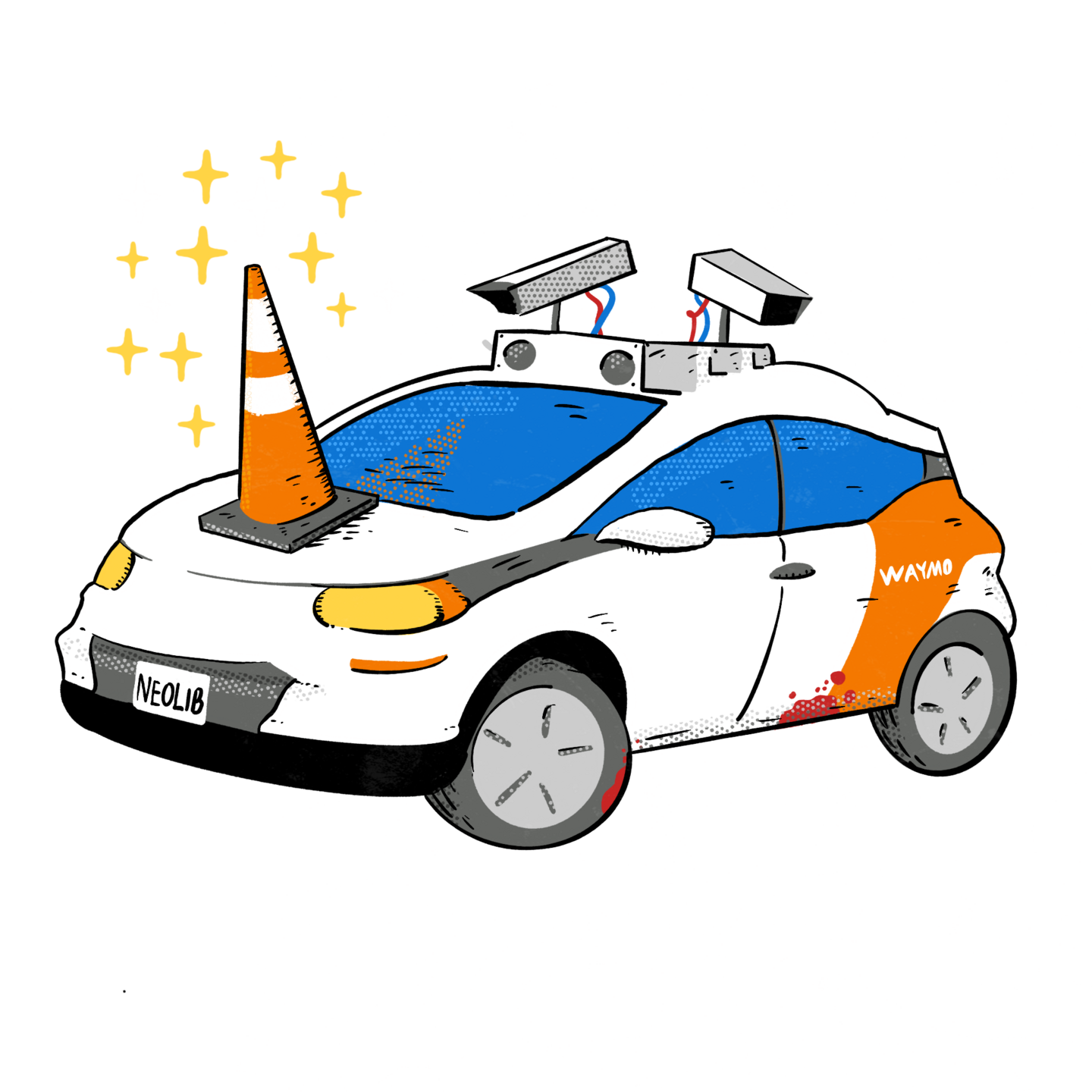
Autonomous vehicles from companies like Waymo and Zoox are set to trigger an increase in car usage that clogs urban streets. Cities should prepare now.
See original article by David Zipper at Bloomberg
Takeaways:
- Research and common sense suggest that self-driven vehicles will cause car use to spike, resulting in logjams that would be calamitous for cities’ quality of life and economic health.
- Autonomous vehicles offer superior car trips, which can lead to people taking more and longer car trips, and workers tolerating longer car commutes, catalyzing sprawl and creating more miles driven.
- Road pricing during peak times can mitigate gridlock by encouraging flexible travel plans and forcing AV companies and customers to consider the delays they impose on others, and setting up a policy apparatus that leverages road pricing can help keep traffic flowing.
Close your eyes and imagine a future featuring ubiquitous autonomous vehicles. What do you see?
Perhaps you envision gleeful commuters freed from the daily tedium of driving themselves to and from work. Maybe you think about passengers dozing, watching videos or taking calls as their robot cars whisk them to their destinations. You might picture quieter, cleaner cities; since AVs are typically electric, they emit a gentle hum rather than the roar and pollution of gas-engine vehicles. If you drive a cab or ride-hailing car for a living, you could be eyeing a potential job killer.
Whatever scene you conjure, it probably doesn’t feature roadways choked with traffic. But it should.
If and when self-driven vehicles become widespread, research and common sense both suggest they will cause car use to spike. The resulting logjams would be calamitous for cities’ quality of life as well as their economic health — unless public leaders enact preemptive policies to keep people moving.
To understand why AVs will induce additional driving, consider the reasons that American robotaxi companies have spurred so much excitement among their investors and early customers. Self-driven vehicles offer superior car trips, particularly when compared with regular ride-hailing services or taxis. Today’s robotaxi passengers can set the temperature and select their favorite music, and they need not worry about a driver eavesdropping on private conversations or judging off-key singalongs. For regular users, robotaxi companies like Waymo, Zoox and Tesla also provide reliable consistency across their fleets of identical vehicles using the same software and hardware.
These advantages can be substantial. Case in point: Waymo’s Bay Area riders pay a premium of at least 10% to take a robotaxi instead of human-driven ride-hail.
How do people respond when an experience improves? They want to do more of it.
It’s a safe bet that AV customers will take more and longer car trips than they would have if they (or another person) sat behind the wheel. Some of those autonomous rides would have otherwise occurred on transit or by bicycle, or perhaps never happened at all. Given the pleasantness of traveling in an AV, workers will also tolerate longer car commutes, catalyzing sprawl (and creating yet another headache for America’s beleaguered transit agencies, which rely on density to provide efficient service). All of these behavior changes point in the same direction: more miles driven.
Then there is the issue of “deadheading,” industry parlance for the driving that occurs without any passenger inside the vehicle, as when an AV is en route to a pickup, waiting for its next summons, or headed toward a recharging station. As of late 2025, deadheading represented almost half of Waymo’s total miles driven in the Bay Area.
In a recent academic paper, University of Texas-Arlington engineering professors Farah Naz and Stephen Mattingly reviewed 26 prior studies evaluating how autonomous vehicles will affect total vehicle miles traveled (VMT). They estimated a VMT rise of 6% attributable to AVs, with the anticipated increase a bit higher for privately owned AVs and slightly lower if robotaxis remain the dominant format.
Each vehicle mile that AVs induce will impose costs on society, including additional crashes (since any car trip carries a degree of risk) as well as pollution from tires and the generation of electricity.
Read more: We Still Don’t Know if Robotaxis Are Safer Than Human Drivers
Some new self-driven trips will take place at night or over weekends, times when the current roadway network has spare capacity. But others will occur during peak times, when highways and streets are already full. In congested environments, even a slight uptick in the number of vehicles can dramatically slow everyone else on the roadway. The implication: Cities full of AVs will endure more and lengthier traffic jams. Beyond the inconveniences borne by travelers, the gridlock will hamper economic growth since longer and less predictable commutes will narrow the labor pools available to businesses, resulting in less productive matches between employers and workers.
Could the public sector ease AV-induced slowdowns by just widening roadways? Unlikely. Adding lanes is costly in urban settings, both financially and in terms of social and environmental damage. Then there is the principle of induced demand — what economists have dubbed the “iron law of congestion” — which warns that new roadway capacity leads people to take more car trips during peak times, which erodes the short-lived increase in traffic speed.
In other words, autonomous vehicles will cause urban traffic jams that governments cannot untangle.
Those ensconced in self-driving pods might shrug off such inconveniences, passing time stuck in traffic by scrolling on their phones, watching Netflix or catching up on email. But the rest of us — those who still drive their own cars, or ride the bus, or who just live in cities that grow paralyzed by robo-traffic — are unlikely to be so blasé. Given the relative wealth of AV customers, the ascendance of self-driving technology could further widen the gulf between the haves and have-nots that is already baked into the US transportation system.
Worse, those hoping to bolster transit and biking — uniquely space-efficient and climate-friendly forms of urban mobility — will face stiffening headwinds. Convincing car owners to support pedestrian-friendly road changes or convert a traffic lane to a cycletrack is already a herculean task; heavier congestion will make it even tougher.
An AV-inspired surge in driving would be a disaster for cities as well as the environment, but it is not inevitable. The single best way to avoid it: Harness the power of road pricing.
As economists have long argued, a fundamental flaw in American roadway management is the failure to charge drivers for the slowdowns they impose on others. If anything, these inefficiencies could be even more acute for AVs, which when deadheading would worsen congestion without vehicle occupants enduring any of the annoyance experienced by human road users.
But road pricing during peak times, such as managed lanes installed on I-66 in Northern Virginia or the congestion pricing cordon in Manhattan, mitigate gridlock by encouraging those with flexible travel plans to drive earlier or later, or perhaps use transit or a bike. Similar charges could force AV companies and their customers to consider the delays they force others to bear (higher fees for deadheading miles seems like an especially smart policy). The amount of these charges can always be adjusted later, as AVs scale. The crucial first step is setting up a policy apparatus that leverages road pricing to keep traffic flowing.
The wisest time to enact such reforms is now — before a self-driving surge brings roadways to a halt. Depending on the posture of regulators and the rate at which autonomous technology advances, that moment could be decades away, or it could come much sooner. But in the absence of road pricing, it seems inevitable.
See original article by David Zipper at Bloomberg