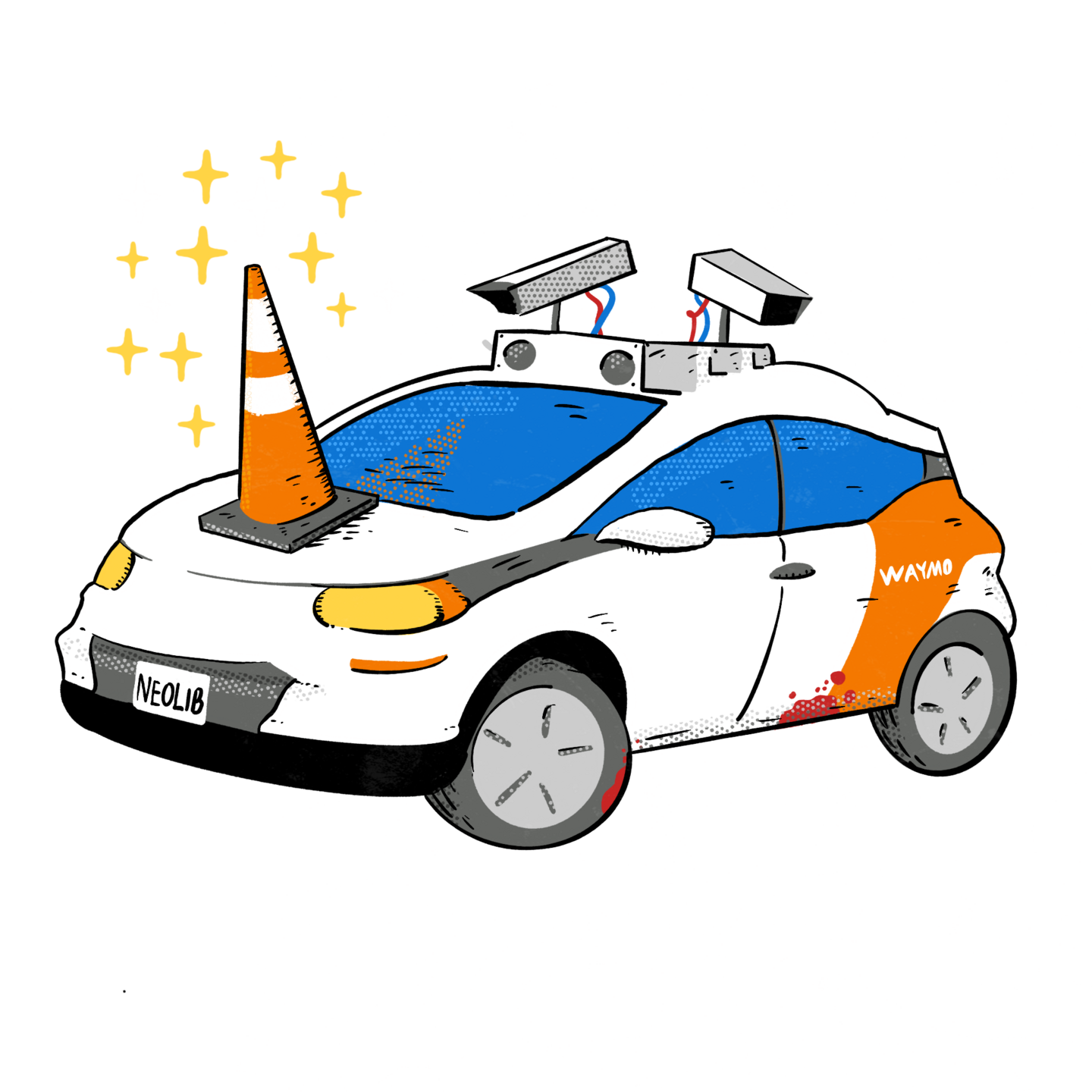
SF Chronicle – A toddler fell in an S.F. crosswalk. Then her dad saw a Waymo coming
Editors note: The main question is why are Waymos behaving aggressively, even on Slow Streets, even when small children are present. If the vehicle detected that a small child was crossing the street shouldn’t it have then behaved more cautiously?
See original article by Rachel Swan at the SF Chronicle
The girl lay face down with her tiny legs splayed in a Noe Valley crosswalk, clearly distraught as a Waymo robotaxi crawled toward her.
In a split second, her father rushed into the path of the driverless car, pushing a stroller right up to its bumper. It stopped feet away from his 2-year-old daughter. Bystanders shouted from the surrounding sidewalks. The girl burst into tears.
“I think my child could have very easily been killed,” the father, Ben Fisher, told the Chronicle, recalling how a walk with his daughter on Friday led to a fight-or-flight scene in one of San Francisco’s sleepy neighborhoods. Shortly after 9:30 a.m. the pair began crossing at Sanchez and Duncan streets, Fisher pushing his daughter’s pedal-less training bike along in a stroller.
He clocked the Waymo to his left, pausing at a stop sign before it climbed west up the hill. Had this been a human driver, it would be reasonable, Fisher thought, to assume that the car would remain in place. But just as she tripped and stumbled, he saw the machine nose into the intersection.
There are two narratives of the moments that followed, one from a terrified dad who believed he was about to watch his daughter get struck by a car, the other from a powerful tech company whose staff touts its safety record while trying to build trust with the public. The details mostly align. The perspectives do not.
This incident comes at a moment when Waymo and other companies are flooding streets with autonomous or largely automated vehicles, prompting anxiety over safety and the incursion of tech into everyday life. Though many people want the cars to be predictable and human-like, others criticize them for being overly-cautious — in the past, some San Franciscans would troll Waymo by placing cones in front of the vehicles to immobilize them. Others insist AVs should be held to a much higher standard than the average human driver.
Waymo became a potent symbol of the Big Tech bogeyman when one of its cars ran over a cat in the Mission District last year. The company, and its peers, have to constantly grapple with who, exactly, the model driver should be: A stickler for rules who dawdles at the stop sign until every last pedestrian has crossed, or a more assertive motorist who lingers just a beat before nudging forward?
In this case, Fisher contends, the more careful approach would have been the right one. Stay at the stop sign and wait for the 2-year-old to toddle across the street.
“The legal requirement is to yield to pedestrians in a crosswalk,” he said. “Not to bully them and hurry them on their way.”
He became convinced that the Waymo had not detected his small child sprawled in the street. Spokespeople at Waymo said the self-driving vehicle sensed both pedestrians, prompting it to slow and come to a full stop about 13 feet from them, midway through the intersection. A “yield” signal with the universal “person walking” iconography blinked from the LiDar sensor on the dome of the Waymo. This feature conveys to pedestrians and other motorists why a Waymo has halted.
Notably, officials at Waymo say Fisher did not cause the car to stop by pushing a stroller in front of it; by that time, they say, the vehicle had stopped.
“While the vehicle operated safely, we know the importance of ensuring that other road users feel confident and comfortable around our technology, and we continuously work on communicating vehicle intent to other road users,” the company said in a statement.
Those assurances have not placated Fisher and others who witnessed what they perceived as a near-collision that Friday morning. Fisher and his wife submitted an incident report to Waymo and filed a police report, as well as a complaint with the city’s 311 system. There was a passenger in the Waymo who also submitted a report to the company, Fisher said. (Waymo was not able to immediately confirm receipt of that report.) In frustration, Fisher also flagged the incident to Mayor Daniel Lurie and Supervisor Rafael Mandelman’s offices.
He said that on some level, his daughter seemed aware that she could have been hit — a possibility the company denies.
“Bad rainbow!” she said, referring to the robotaxi, after her father picked her up from the street.
See original article by Rachel Swan at the SF Chronicle