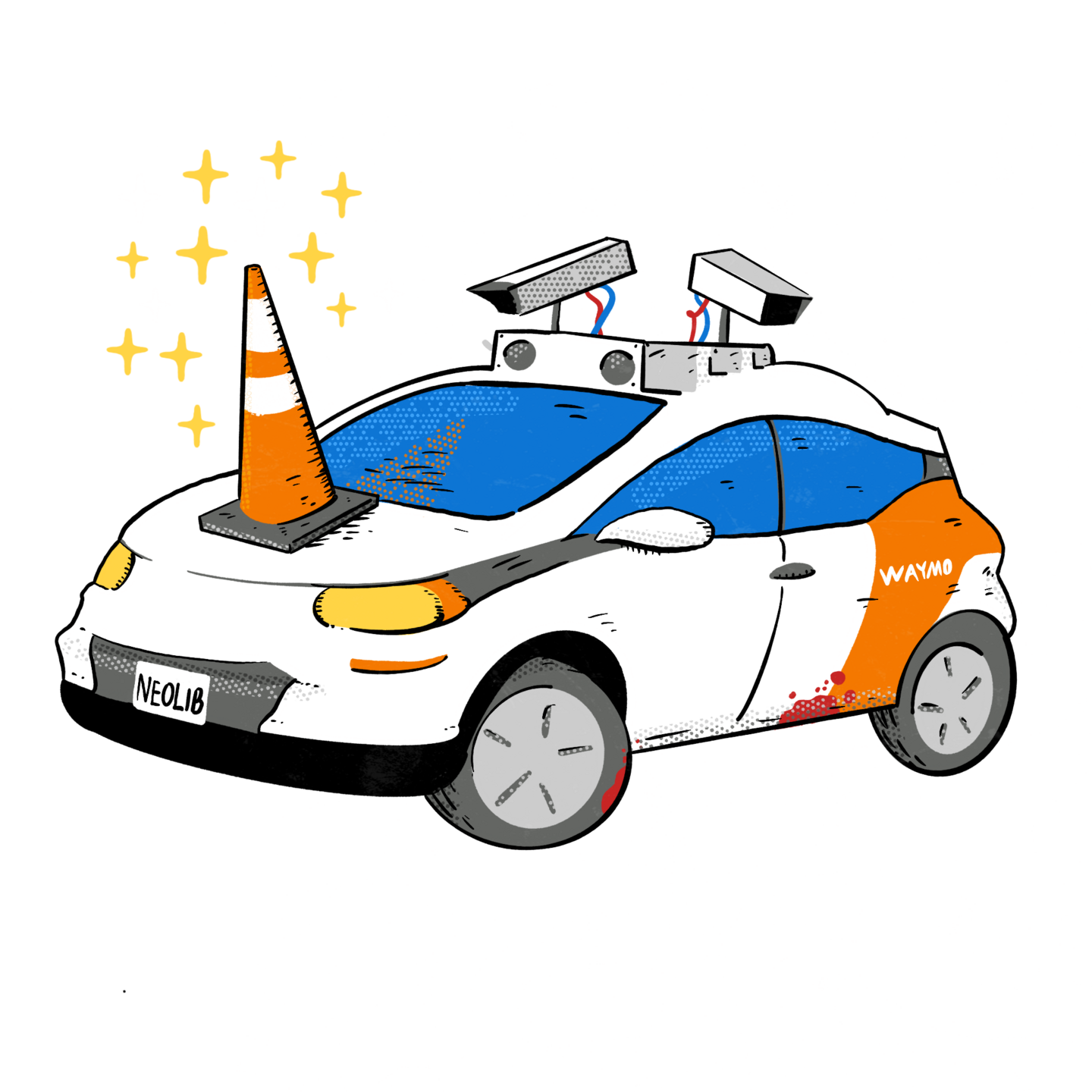
SF Chronicle – Waymos are now coming for your coveted San Francisco parking spots
Editors note: hey, what happened to the promise that robotaxis were going to free up parking spaces since they don’t need to use them???
See original article by Rachel Swan at the SF Chronicle
A long stretch of curb in San Francisco’s Mission District might contain a whole menagerie of parked vehicles: hatchbacks, SUVs, dusty pick-ups, chic Teslas.
And recently, Waymo robotaxis.
That’s what Kyle Grochmal saw walking through the northeast Mission District on Monday afternoon. Cutting down York Street, he glimpsed a tell-tale white electric Jaguar in one of the coveted one-hour spots, its sensors spinning. The Waymo sat there for at least 20 minutes, Grochmal said. He whipped out his cell phone and started recording.
After the Waymo drove off, another one showed up within an hour and took the same spot.
“This is something I started to notice about six months ago,” Grochmal said, recalling how disorienting it was to be strolling down a largely deserted sidewalk, and suddenly hear the purring motor and soft click of autonomous vehicle cameras. He’d look up to see a Waymo “just sitting there, not loading anyone.”
Spokespeople for Waymo declined to speak on the record, though the company has maintained that the vehicle Grochmal saw on York Street had stopped between trips for less than an hour, as allowed by the street sign. (Residents with permits on their vehicles can park indefinitely in such zones.)
But Waymo’s use of public curb space raised questions for Grochmal, who wonders whether San Franciscans are prepared to have their infrastructure dominated by autonomous vehicles.
“Say Tesla gets to self-driving, so people have personal AVs,” he said. “So then do people from Palo Alto get dropped off in San Francisco and let their cars drive around all day searching for free parking?”
Such a future seems particularly unsettling in the northeast Mission, where snug streets couldn’t handle much traffic, and competition for parking is already fierce. A recent influx of Artificial Intelligence companies brought many more workers and cars, as well as robotaxis that trawl the blocks, waiting for fares. It makes sense, to Grochmal, that some of them wind up squatting in one-hour spaces.
UC Berkeley Professor Daniel Chatman said he understands Waymo’s calculus, in that it’s more cost effective to keep vehicles stationary at a curb than to have them driving around empty. Transportation experts have a term of art, “zombie miles,” for distances traveled by an AV that isn’t carrying passengers. Such trips are wasteful because they drain battery power and needlessly subject the vehicle to road dangers.
A one-hour parking space in an area with a lot of potential customers is an attractive resource for Waymo, Chatman said, noting that the time constraint would dissuade human drivers from vying for the same spot.
“I would guess that Uber and Lyft drivers have been parking in places like that,” Chatman posited, “to the extent that there are delays in their next fare or if they want to take a break.”
Kieran Farr, a resident of the northeast Mission neighborhood and former member of the Mission Creek Business Association, said he has no objections to robotaxis occupying space at times when there isn’t high demand (for example, an afternoon in late December). A former taxi driver himself, Farr described the sit-and-wait game as a “convenience” and a “frequent tactic” for commercial drivers. The contemporary image of a parked or idling AV with no one behind the wheel draws from a much older trope — that of the bored taxi driver with his coffee and newspaper.
Still, it’s conceivable that residents will lose patience with Waymo, and other AV companies, as the fleets scale up and the vehicles compete more aggressively with humans for parking.
Traditionally, economists and policymakers have solved the demand problem by placing meters on curbs. If San Francisco were to charge for parking in the now-mostly-unregulated northeast Mission, then Waymos might move elsewhere.
Grochmal sees metering as the answer to what could otherwise be parking chaos, if humans have to fight with AVs that are optimized to find all the free spots. It may be difficult to imagine this future when parked Waymos are still so uncommon that they prompt passersby to pull out their phones and record.
Yet as technology and markets evolve, more self-driving cars will inevitably fill San Francisco streets. And the birthplace of innovation will have to contend with a basic quandary of urban living: Where to put all these cars?
See original article by Rachel Swan at the SF Chronicle