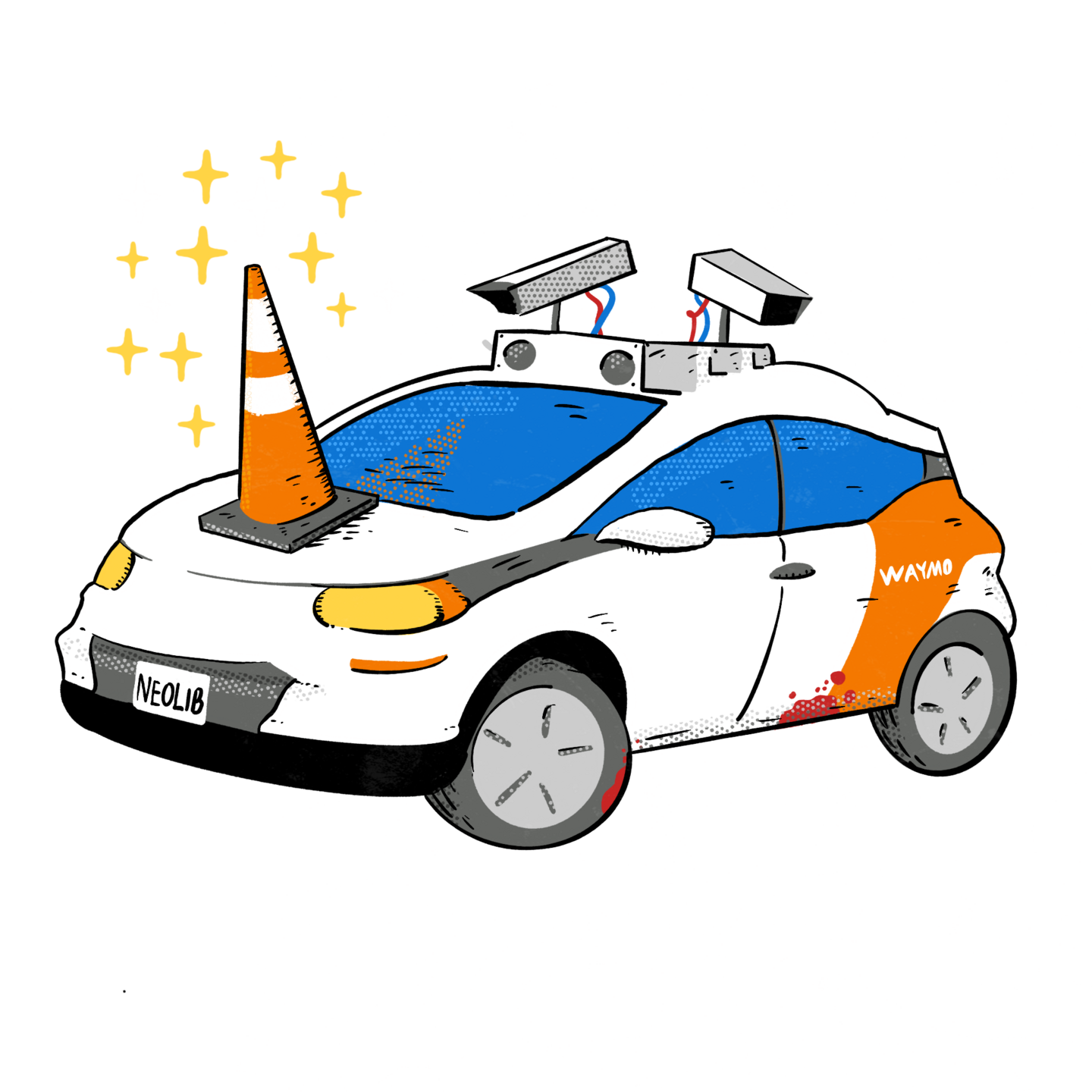
SF Standard – Robot turtles: Waymo’s next-gen cars could be buggy Hyundai EVs
The robotaxi company is reportedly buying 50,000 Ioniq 5s. The problem? Owners say their cars keep dying.
See original article by Michelle Peng at SF Standard
The next Waymo you take may look a little different.
The autonomous vehicle company reportedly plans to buy 50,000 Hyundai Ioniq 5s, and eagle-eyed San Franciscans have already spotted(opens in new tab) the SUVs(opens in new tab), outfitted with Waymo’s distinctive sensors, around town.
Since the Ioniq 5 launched in 2021, it’s been showered with accolades from Car and Driver(opens in new tab), Kelley Blue Book(opens in new tab), and Edmunds(opens in new tab).
There’s just one problem: Owners — including me — say their Ioniq 5s keep failing.
Drivers point to the integrated charging control unit, or ICCU, an electrical component that converts high-voltage charge to low-voltage charge. When it breaks, seemingly at random, cars can experience charging failures and power loss on the road, leaving them undriveable.
In a Waymo, that could put pressure on a self-driving algorithm to respond quickly to an unexpected failure and leave riders stranded.
I know the risks first hand. When my Ioniq 5 failed at just over 30,000 miles, it stopped charging on low-voltage chargers, and a trip to my Hyundai dealership revealed a busted ICCU. More than a month later, I’m stuck in a rental and waiting for a new part amid a nationwide shortage of components.
Still, I’m one of the lucky ones. It’s far more common for ICCU failures to trigger what’s known as “turtle mode,” when the car automatically throttles down the power, limiting speed to about 20 mph and notifying users with an error message — accompanied by a cartoon turtle.
I talked to half a dozen Ioniq 5 owners across California who told me nearly identical stories about their ICCUs failing in the past three months.
They loved the cars at first, drawn in by the glowing reviews and won over by the features: a large battery that charges quickly; comfortable and roomy interiors; an interface with manual buttons; smooth and quiet acceleration; and, for some, the fact that it isn’t a Tesla.
Then, one day, they heard a “pop” from the back of the car and saw an error message with the “turtle mode” icon near the speedometer.
Most limped home to their driveways, scheduled a service appointment, and called a tow truck to take their cars to the shop.
When John Higham and his wife heard the pop in their 2023 Ioniq 5, they decided to charge up the battery overnight and drive it from their home in Mountain View to the closest dealership, about five miles down the freeway.
His wife “barely got off our street before it went into turtle motor mode again,” said Higham. “She drove that car in turtle mode with a top speed of 20 mph on surface streets for seven miles before she finally got to the dealer.” He added, “I don’t know if it was the best choice, but at least she didn’t get killed in the process.”
Hyundai says only 1%(opens in new tab) of Ioniq 5s have ICCU problems, but many owners suspect the issue is much more common. Consumer Reports estimates that the figure could be as high as 10%, based on its 2026 reliability survey(opens in new tab) of more than 380,000 vehicles that use the same ICCU, including models from Hyundai, Kia, and Genesis.
At the downtown Los Angeles Hyundai dealership, my assigned service adviser estimated that roughly half of Ioniq 5s that get driven off the lot return with an electrical failure. With the parts shortage, that means some owners, like me, are waiting months to get their cars back.
Hyundai is aware of customer concerns about the ICCU, a spokesperson said over email, noting that the company provides repair and replacement under warranty, at no cost to customers, and is “working closely with our suppliers to improve parts flow to dealerships nationwide.”
Waymo and Hyundai announced a strategic partnership in October 2024, with a plan to integrate robotaxi technology into the Ioniq 5. The news of Waymo’s purchase order, estimated at $2.5 billion, was first reported(opens in new tab) in electric-vehicle news site Gasgoo.
Waymo operates robotaxis in 10 cities nationwide, with plans to expand to 20 more. The company has 3,000 cars on the road, more than a third of them in theBay Area.
A Waymo spokesperson said that the company is manually testing prototypes and working on validating the platform for future deployment. When asked how the company plans to address potential failures on the road, the spokesperson said Waymo is “closely aligned with Hyundai’s team regarding the base vehicle platform.”
When Erika Kaestle took her Ioniq 5 to get a replacement ICCU at a dealership in Mission Hills, near Los Angeles, several cars were ahead of her waiting on the same part. It was the second time her ICCU had blown — with just 6,300 miles driven on her car.
While she opted to keep her Ioniq the first time she had an ICCU failure, this time she’s taking a corporate buyback and moving on from Hyundai. “I wouldn’t trust it,” she said. “I can’t have a car that I don’t trust to take on a trip.”
And in spite of her eagerness to try out a Waymo in Los Angeles, Kaestle wouldn’t get into one if it were an Ioniq 5, she said, knowing that the car could enter turtle mode at any time. “I don’t know how it would react if that happened,” she says.
Ray Castro, a former Ioniq 5 owner in Richmond, took a corporate buyback when his ICCU failed last spring. “My concern is that if it’s on a highway, you’re just going to get frickin’ rear-ended,” he said.
As for what he’s driving now, “I went the other direction and got a 2006 Honda Pilot. It’s so sick — just a big ol’ V6, super bad MPG.” Twenty-year-old Pilots might not be as slick as new EVs, he admits. But “they start up almost every time, [and] if something pops up, the common issues are known, and there are solutions for them.”
See original article by Michelle Peng at SF Standard